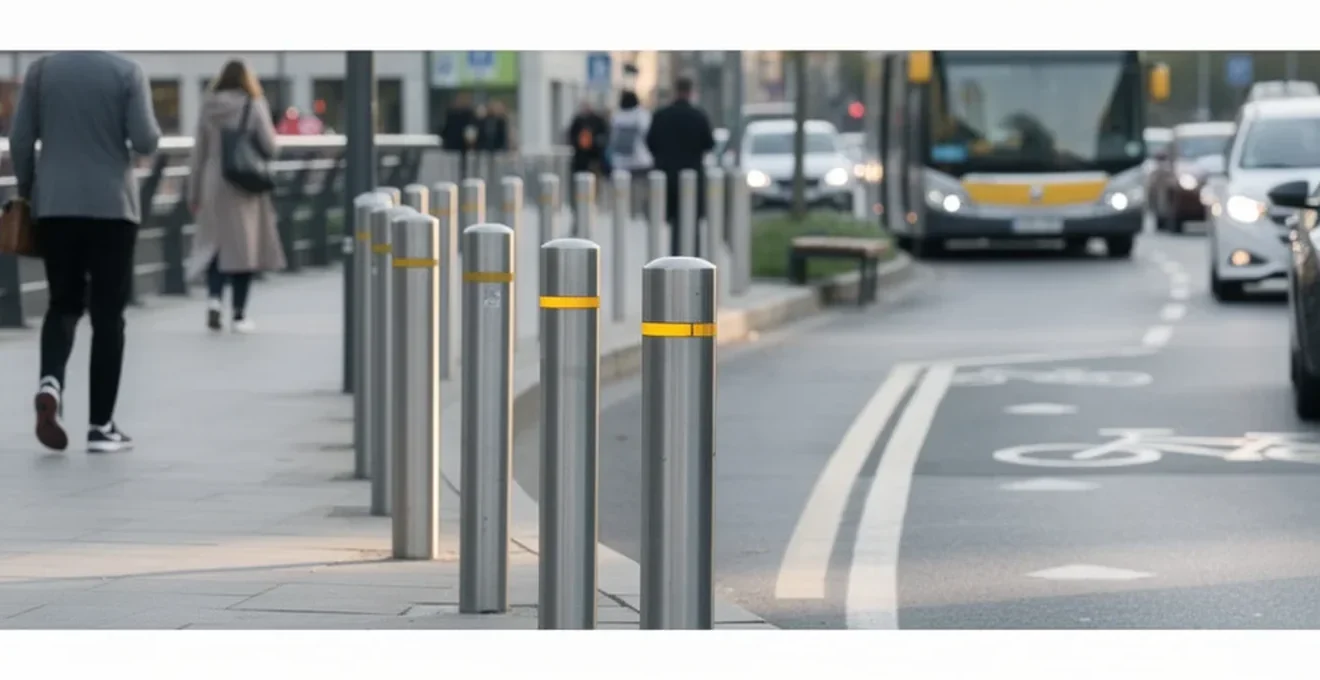
Well-planned street furniture does far more than decorate a pavement. Bollards, guardrails, signage, benches, cycle stands and increasingly « smart » fixtures all play a direct role in controlling how vehicles and people move through public spaces. When positioned correctly, these features reduce road accidents, separate motorists from pedestrians, encourage walking and cycling, and support a safer, more orderly public realm. This article looks at the main categories of street furniture used for traffic and pedestrian management, explaining how each contributes to safety, accessibility and the smoother flow of people and vehicles through towns and cities.
Bollards and vehicle access control systems
Bollards remain one of the most effective and widely used tools for controlling vehicle access. Used correctly, they reduce traffic speed, restrict entry to sensitive areas, and improve both security and pedestrian safety. In pedestrian zones, bollards create a restricted area that vehicles above a certain size simply cannot enter, giving people a safer space to walk and socialise without the risk of vehicle intrusion.
Retractable bollards for dynamic traffic restriction
Retractable bollards allow a space to switch between open and restricted access as needed. This flexibility is useful in areas that must remain accessible to delivery vehicles or emergency services at certain times but closed to general traffic at others, such as market squares or event spaces. Rather than relying on a permanent barrier, planners can control access dynamically according to the time of day or specific operational needs.
Fixed bollards in pedestrian zone delineation
Fixed bollards are the simpler, more permanent option, and they are particularly effective at clearly marking the boundary between pedestrian-only areas and roadways. By creating an unambiguous physical line, fixed bollards help prevent vehicles from encroaching onto footpaths and pedestrianised high streets, reinforcing the sense of a safe, dedicated space for people on foot.
Anti-terrorism bollards and PAS 68 Crash-Rated standards
In locations where security is a heightened concern, crash-rated bollards provide an additional layer of protection. These are designed and tested to resist vehicle impact, helping to prevent hostile or accidental vehicle incursions into crowded pedestrian areas. Choosing bollards that meet recognised crash-rated standards ensures that security measures are both effective and dependable in high-risk or high-footfall locations.
Solar-powered bollard lighting integration
Many bollards now incorporate solar-powered lighting, combining traffic control with improved visibility after dark. Illuminated bollards help drivers and pedestrians identify restricted zones and boundaries at night, reducing the risk of collisions while also cutting down on energy consumption and the need for additional mains-powered lighting infrastructure.
Guardrails and pedestrian guidance systems
Guardrails serve a similar purpose to bollards but are particularly useful for guiding pedestrian movement along a specific route, rather than simply blocking vehicle access at a single point. They channel foot traffic away from carriageways and towards designated crossing points, reducing the likelihood of pedestrians stepping into the road at unsafe locations.
Modular guardrail configurations for High-Footfall zones
In busy areas such as town centre high streets, transport interchanges or event spaces, modular guardrail systems can be configured to suit the specific flow of pedestrians. This adaptability means guardrails can be extended, reshaped or repositioned as footfall patterns change, helping to manage crowd movement without the cost of a permanent, bespoke installation.
Anti-climb barriers near school crossings
Near schools, where the safety of young pedestrians is paramount, anti-climb guardrails help ensure that children use designated crossing points rather than stepping out between parked cars or at unsafe points along the road. This straightforward measure supports safer routes to school and reduces the risk of accidents during the busiest periods of the day.
Tactile paving integration with guardrail systems
Guardrail systems are most effective when combined with tactile paving, which alerts visually impaired pedestrians to the presence of a crossing point or a change in the pedestrian route. Integrating tactile surfaces with guardrail placement ensures that pedestrian guidance systems are genuinely inclusive and accessible to all members of the community, not just those with full sight.
Street signage and wayfinding infrastructure
Clear, well-maintained signage is fundamental to both traffic management and pedestrian confidence. Signs communicate rules, warn of hazards, and help people find their way, all of which contribute to smoother, safer movement through public spaces.
Variable message signs for Real-Time traffic updates
Digital, changeable signage allows local authorities to communicate real-time information to drivers, such as road closures, diversions or congestion warnings. This kind of responsive signage helps reduce bottlenecks by giving motorists the information they need to adjust their route before reaching a problem area, rather than discovering it too late.
Pedestrian wayfinding totems in urban centres
Wayfinding totems and information boards help pedestrians navigate unfamiliar urban environments with confidence. By clearly directing people to landmarks, transport hubs or amenities, this type of signage encourages walking as a practical and enjoyable way to explore a town or city centre, supporting the wider goal of pedestrian-friendly urban design.
Retroreflective signage compliance with TSRGD regulations
Traffic signs must be clearly visible in all lighting conditions, which is why retroreflective materials are used to ensure signs remain legible after dark or in poor weather. Compliance with the relevant traffic signs regulations is essential, both to maintain consistency across the road network and to ensure that signage is legally enforceable and genuinely effective at guiding driver and pedestrian behaviour.
Benches, seating and pedestrian rest zones
While benches are often seen as a simple amenity, they play a meaningful role in encouraging people to spend time in public spaces rather than passing through them quickly. Seating areas support social interaction, give people a reason to pause, and make town centres more welcoming, particularly for older residents, parents with young children, and those with limited mobility.
Strategic bench placement along high streets
Positioning benches at regular intervals along a high street, and particularly near bus stops, parks and shopping areas, allows pedestrians to rest without having to plan their journey around limited seating. Placing benches so they face one another, rather than in isolated, wall-facing positions, also encourages conversation and helps foster a stronger sense of community.
Anti-loitering bench design considerations
Seating design must also address safety concerns. Poorly placed or isolated benches, especially where lighting is inadequate, can sometimes attract antisocial behaviour and make an area feel less secure after dark. Thoughtful design and positioning, informed by an understanding of how a particular community uses its public spaces, help ensure that seating remains a welcoming feature rather than a source of concern.
Cycle parking and Multi-Modal transport hubs
Encouraging cycling is a key part of reducing car dependency and easing pressure on road networks. Secure, well-located cycle parking sends a clear signal that a street has been designed with more than motor vehicles in mind.
Sheffield stands versus Two-Tier cycle racks
Sheffield stands are a simple, widely used option that allow cyclists to lock their frame and wheel securely, and they work well in most on-street settings. Two-tier racks, by contrast, make more efficient use of limited space by stacking bicycles vertically, which can be particularly useful at busy transport interchanges where demand for cycle parking is high but ground space is limited.
Cycle hire docking stations and modal shift strategies
Cycle hire docking stations support a broader shift away from private car use by making cycling a convenient, on-demand option for short journeys. Integrating these docking points into wider transport planning helps connect cycling with other modes of transport, supporting a more flexible, multi-modal approach to getting around a city.
Segregated cycle lane kerbing solutions
Physically separating cyclists from motor traffic using kerbing or low barriers reduces the risk of collisions and gives cyclists the confidence to use a route rather than avoiding it. Segregated lanes also help clarify road space for drivers, reducing the uncertainty that can arise when cyclists and vehicles share the same carriageway.
Smart street furniture and IoT-Enabled traffic management
Street furniture is increasingly being adapted with technology to provide additional functionality beyond its traditional role. Connected, sensor-equipped fixtures can gather data and respond to real-world conditions, supporting more responsive and efficient management of both traffic and pedestrian movement.
Sensor-equipped bollards for footfall analytics
Bollards fitted with sensors can track pedestrian and vehicle movement, giving planners useful data on how a space is actually being used. This information can then inform decisions about where additional seating, lighting or crossing points might be needed, ensuring that future street furniture investments are based on genuine usage patterns rather than assumptions.
Adaptive traffic signals linked to street furniture networks
When traffic signals are connected to a wider network of sensors and street furniture, they can adjust in real time to changing conditions, such as a surge in pedestrian crossings or a build-up of vehicle traffic. This adaptive approach helps reduce unnecessary waiting times for both drivers and pedestrians, improving the overall flow of a busy junction or high street.
Solar-powered smart bins reducing pedestrian congestion points
Overflowing bins can create obstructions on narrow pavements, forcing pedestrians into the road and disrupting foot traffic. Solar-powered smart bins that monitor their own fill levels allow waste collection teams to respond before bins overflow, keeping walkways clear and reducing one of the small but significant congestion points that can affect pedestrian flow in busy areas.