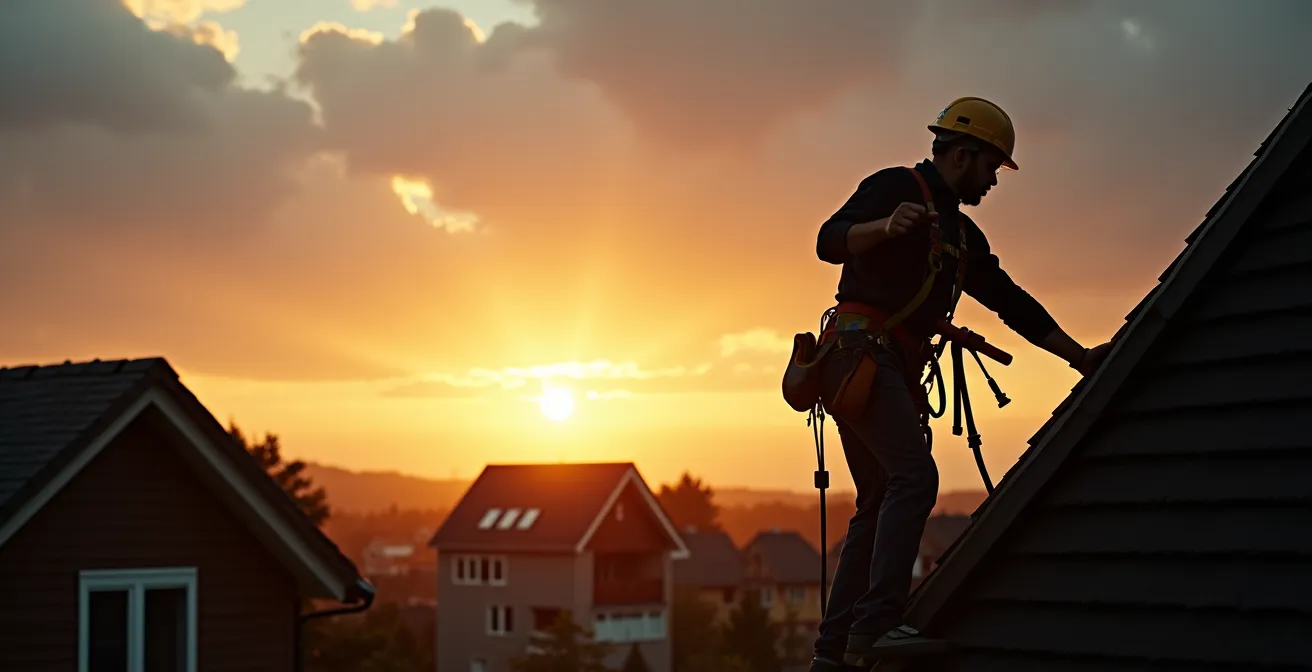
Every descent breaks your workflow. You’re halfway through shingling a 10/12 pitch when you realize the utility knife is sitting in the truck. Down the ladder, grab the tool, climb back up—fifteen minutes gone. Multiply that scenario across a workday, across a project, and the inefficiency compounds into something far costlier than lost minutes.
The frustration is acute on steep-pitch roofs where gravity multiplies every small decision into a potential safety event. Traditional approaches to tool organization fail catastrophically above certain angles, yet most safety guidance treats all roofs identically. For professionals working slopes of 7/12 and steeper, this gap between generic advice and field reality creates both productivity drain and genuine risk exposure. Modern roofing solutions from bmfroofingsolutions.com have evolved to address these specific challenges through engineered anchoring systems designed for the unique physics of steep slopes.
The path forward requires quantifying what these interruptions actually cost, understanding why conventional anchoring fails on aggressive pitches, and implementing strategic placement systems that align with actual work patterns. This isn’t about buying more equipment—it’s about deploying the right equipment in positions dictated by movement analysis rather than convenience.
Steep Roof Anchoring: Your Efficiency Blueprint
Professional roofers lose hours weekly to ladder trips on steep pitches, but strategic tool anchoring transforms this workflow liability into competitive advantage. The critical threshold is 7/12 pitch—where standard anchors engineered for vertical fall loads fail against lateral force vectors. Success requires mapping your movement patterns before selecting equipment, matching anchor capacity to specific slope angles and load types, then calculating actual time recovery across your project pipeline to validate the investment.
The Hidden Tax of Constant Ladder Descent on Steep Roofs
The obvious cost is time—five minutes here, ten minutes there. But the arithmetic of interruption underestimates the true tax. Each ladder trip doesn’t just consume the minutes spent climbing; it fractures concentration, resets muscle memory, and forces your brain to rebuild the spatial awareness you’d established on the roof plane.
Consider a typical reroof where you descend twenty times across an eight-hour shift. The first trip down feels routine. By the tenth descent, fatigue has degraded your foot placement precision. Your brain’s risk-assessment capacity has been depleted by hundreds of micro-decisions about hand grip and weight distribution. This cognitive load compounds with physical exhaustion in ways that simple time tracking misses entirely.
The multiplication effect becomes statistically undeniable when examining injury data. Research reveals that 81% of construction emergency room fall injuries are ladder-related, with the majority occurring during routine descent rather than ascent. Each trip represents a fresh probability roll where cumulative fatigue has loaded the dice against you.
Construction workers made up nearly half (49%) of all fatal occupational slips, trips, and falls
– CDC NIOSH Science Blog, Centers for Disease Control and Prevention
Beyond individual risk, there’s the crew coordination dimension that rarely appears in safety training. When one roofer descends to retrieve a tool, the entire team’s rhythm fractures. The worker holding shingles in position is now waiting. The crew member running the nail gun has paused mid-sequence. What appears as one person’s five-minute errand has actually consumed fifteen crew-minutes of productive capacity.
Project timelines suffer from accumulation that defies initial estimation. You bid the job assuming efficient workflow, but “just a few minutes” repeated fifty times across the roof becomes four hours of pure inefficiency. That margin evaporates, pushing completion into overtime or forcing rushed work as the deadline approaches.
| Injury Type | Annual Cost | % of Total |
|---|---|---|
| Falls to Lower Level | $3.56 billion | 33.8% |
| Overexertion | $2.21 billion | 21.0% |
| Struck by Object | $1.40 billion | 13.2% |
The financial impact extends beyond direct injury costs into workers’ compensation premium increases, project delays, and reputation damage. A single recordable incident can elevate insurance rates for years, effectively taxing every future project to pay for one moment of preventable inefficiency.

The physical toll manifests in subtle degradation of decision-making quality throughout the workday. A roofer who has climbed up and down fifteen times is making different risk calculations than one who has remained continuously positioned. Fatigue doesn’t announce itself with clear warning signs—it quietly erodes judgment until a routine movement becomes a critical error.
Why Standard Roof Anchors Fail Above 7/12 Pitch
The 7/12 pitch threshold represents a fundamental shift in physics that most anchoring systems weren’t engineered to handle. At slopes below this ratio, gravity’s primary vector remains relatively vertical. Tools and materials tend to stay where you place them with minimal securing force. Cross that threshold, and lateral forces begin to dominate the equation.
Standard roof anchors draw their design specifications from fall protection engineering. They’re rated for catastrophic vertical shock loads—the scenario where a worker’s full body weight drops suddenly onto the arresting system. These anchors excel at absorbing energy transmitted along a vertical axis, but that’s fundamentally different from the sustained lateral pull created by a tool bucket hanging on a 10/12 slope.
The friction coefficient between anchor base and roofing material changes dramatically with angle. A friction-based anchor that grips adequately at 5/12 pitch loses effectiveness exponentially as slope increases. On composition shingles above 8/12, the same anchor can slip during normal use because the contact pressure vector has rotated beyond the material’s grip capacity.
Temperature compounds this mechanical challenge in ways that become critical on exposed roof surfaces. Morning installation at 65°F establishes one set of material properties. By midday, when asphalt shingles reach 140°F, the substrate softness has changed, expansion has occurred, and the anchor that felt secure at dawn may now be compromised. Metal roofing introduces thermal expansion in the opposite direction, creating gaps where anchors had been tight.
The industry data underscores this gap between theory and application. Despite widespread anchor availability, 110 roofing workers died from fall-related injuries in 2023, suggesting that mere presence of safety equipment doesn’t guarantee appropriate equipment for the specific conditions.
Ridge Pro System Performance on Steep Slopes
The Ridge Pro anchor system, designed specifically for steep roof pitches from 7/12 to 12/12, provides continuous fall protection through an innovative ridge-mounted anchor line. Unlike standard anchors designed for vertical shock loads, this system accommodates the lateral forces created by steep slopes.
Material-specific failures reveal why one-size-fits-all anchoring creates false security. Composition shingles compress under point loads, allowing anchors to gradually migrate downslope. Metal roofing’s smooth surface defeats friction-based grips unless anchors incorporate mechanical interference. Clay tile’s brittleness means anchors must distribute load across multiple tiles rather than concentrating force.
The engineering mismatch becomes obvious when examining load direction. Fall protection anchors assume force application from above—a worker falling generates downward then outward pull. Tool anchoring on steep slopes creates sustained diagonal force as gravity constantly pulls the tool bucket toward the eave. These are different stress patterns requiring different anchor geometries.
Critical Factors in Steep Roof Anchor Failure
- Assess roof pitch to determine if it exceeds 7/12 ratio where lateral forces increase exponentially.
- Evaluate anchor point capacity for both vertical and horizontal load vectors.
- Verify anchor compatibility with specific roofing material (metal, shingle, tile).
- Consider temperature-related expansion/contraction effects on anchor grip.
Workflow Mapping: Placing Tools Where Motion Happens
Most tool organization happens by default rather than design. Anchors get placed where installation is convenient, tool buckets hang wherever there’s an available attachment point, and material staging occupies whatever space seems accessible. This reactive approach guarantees inefficiency because it ignores the actual geography of your work patterns.
Strategic placement begins with documentation—spending thirty minutes mapping how you actually move across different roof types. For a standard three-tab shingle installation, track which tools you reach for most frequently, where you position yourself during different phases, and how your dominant hand orientation affects reach radius. This movement intelligence reveals placement opportunities invisible to generic planning.
The concept of efficiency triangles comes from commercial kitchen design but applies perfectly to steep roof work. Your most frequently accessed tools should fall within a reach radius that requires minimal position shifting. For right-handed roofers working upslope, that typically means primary tools anchored slightly right of center within arm’s length. Secondary tools—used occasionally but needed predictably—occupy a second tier requiring lean but not repositioning.
Material flow represents a distinct challenge from tool access. Shingle bundles, fastener boxes, and waste collection require different anchor strategies because the weight is dynamic rather than static. A tool bucket might hold fifteen pounds consistently; material staging might shift from fifty pounds to empty within an hour. Your anchoring system must account for this variation without requiring constant adjustment.
| Placement Method | Time Saved/Day | Safety Incidents |
|---|---|---|
| Random Placement | Baseline | 4.2 per 1000 hrs |
| Zone-Based | 45 minutes | 2.8 per 1000 hrs |
| Motion-Mapped | 90 minutes | 1.6 per 1000 hrs |
Crew size fundamentally alters optimal geometry. Solo work concentrates everything within one person’s movement envelope, creating a tight cluster of anchor points. Two-person crews need coordination between positions—placing shared tools at the midpoint of frequent exchange. Three-plus crews often benefit from staged zones where material flows through defined handoff points rather than everyone accessing a central pile.
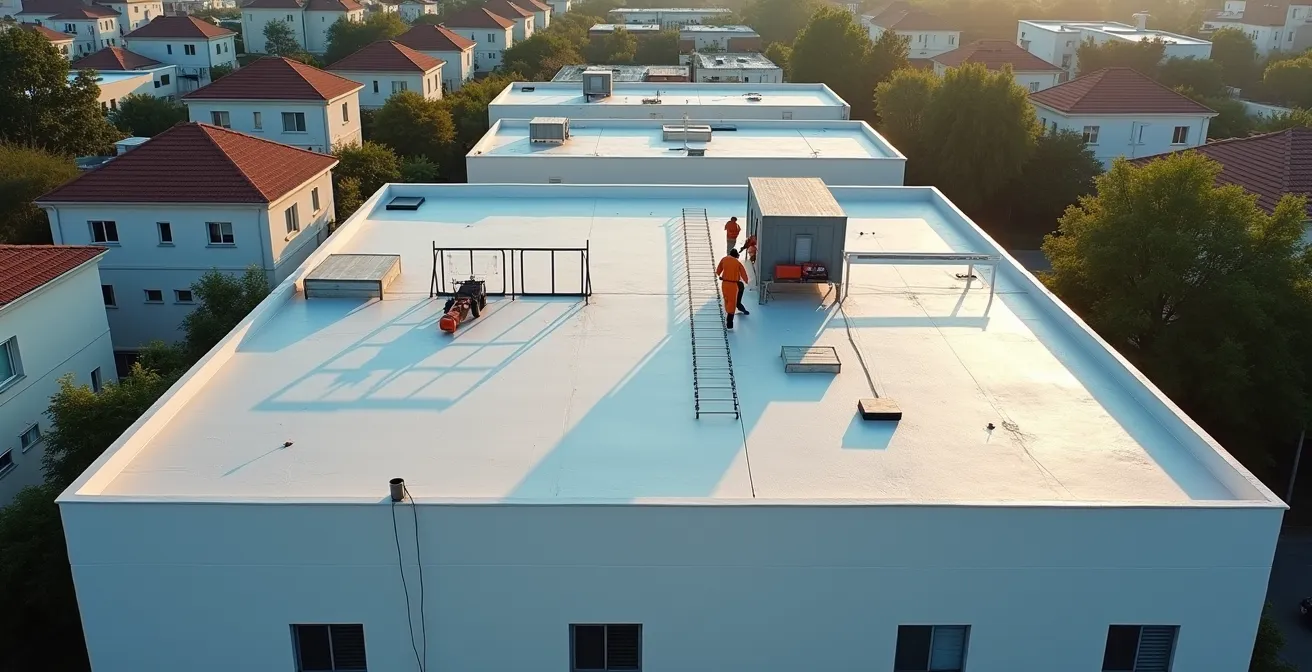
The analysis extends beyond the roof plane itself. Anticipating your movement direction throughout the day—generally working from ridge toward eaves, left to right or right to left depending on sun position—allows you to position anchors that will remain accessible rather than ending up behind your work zone. Tools anchored beautifully at 9 AM become useless by 2 PM if they’re now upslope of your current position on a steep pitch where climbing back is dangerous.
Matching Anchor Types to Slope Severity and Load
The anchor selection matrix operates on three variables that most guidance treats in isolation: exact pitch measurement, project duration, and load characteristics. Getting any one variable wrong compromises the entire system regardless of how well you address the other two.
Pitch-specific selection starts with precise measurement rather than approximation. The difference between 8/12 and 10/12 pitch isn’t subtle—it represents a significant change in lateral force magnitude. Ridge hooks that perform adequately at 8/12 may reach their engineering limits at 9/12. By 10/12, you’ve entered territory where permanent mounting or engineered solutions become necessary rather than optional.
At the 8/12 to 9/12 range, quality ridge hooks still function effectively for static tool loads. These anchors hook over the ridge itself, using the roof’s peak as a natural anchor point. The system works because the opposing roof slope provides counter-tension. For temporary projects—single-day repairs or inspections—this remains the most efficient solution.
Cross into 10/12 territory and sustained loads require bolted systems. The Ridge Pro category represents purpose-built solutions where anchors integrate with the roof structure itself rather than relying on surface friction or ridge hooking. These systems distribute load across multiple attachment points and often incorporate continuous anchor lines allowing movement along the roof plane without disconnecting.
| Roof Pitch | Static Load Anchor | Dynamic Load Anchor | Max Weight |
|---|---|---|---|
| 7/12 – 9/12 | Ridge Hook | Permanent Mount | 310 lbs |
| 10/12 – 12/12 | Ridge Pro | Bolted System | 400 lbs |
| Above 12/12 | Engineered Mount | Custom Solution | Varies |
Project duration economics shift the calculation between temporary and permanent installation. For contractors specializing in steep-slope work, the labor cost of installing and removing temporary anchors across multiple projects quickly exceeds the installation cost of permanent mounts. A permanent anchor system installed once serves twenty projects; temporary anchors consume setup time on every job.
Load calculation requires distinguishing between static tool weight and dynamic material staging. Your utility knife, hammer, and nail gun represent static load—consistent weight that doesn’t shift dramatically. Material staging introduces dynamic loading where a bundle drop or wind gust can momentarily spike forces well beyond the average weight. Safety margins for dynamic loading typically require doubling the calculated capacity.
Roof material compatibility introduces another selection filter. Composition shingles allow certain anchor types that would damage clay tile. Metal roofing requires anchors that won’t mar the surface or compromise weather-sealing. The substrate beneath the finish material matters too—anchors that work on plywood decking may fail on skip sheathing or metal purlins. Given the current economic landscape where the median annual wage for professional roofers in 2024 is $50,970, investing in appropriate equipment represents a manageable percentage of annual revenue while protecting the earning capacity that depends on avoiding injury downtime.

The integration of professional contractors into broader construction safety initiatives has elevated anchoring standards across trades. Understanding load ratings requires reading manufacturer specifications carefully—the prominently displayed number often represents ultimate strength rather than working load limit. Working load represents the safe sustained capacity, typically one-quarter to one-fifth of ultimate strength. An anchor rated for “5,000 lbs” might have a 1,000-pound working load limit, which matters when you’re hanging tool buckets and material.
Key Takeaways
- Ladder descent inefficiency compounds into measurable cognitive fatigue and multiplied injury probability beyond simple time loss.
- The 7/12 pitch threshold fundamentally changes force vectors requiring anchors engineered for lateral loads, not just vertical fall protection.
- Workflow mapping before equipment purchase transforms anchoring from reactive placement to strategic efficiency optimization based on actual movement patterns.
- Anchor selection must match three variables simultaneously: precise pitch measurement, project duration economics, and static versus dynamic load characteristics.
- Time recovery calculation across project pipelines provides concrete ROI methodology proving anchoring investment through measurable productivity gains and safety incident reduction.
Calculating Time Recovery Across Your Project Pipeline
The investment conversation shifts from “does this seem useful” to “here are the actual returns” when you implement tracking methodology. Before deploying new anchoring systems, establish baseline measurements on typical projects. Count ladder descents, time the interruptions, and document the specific triggers—forgotten tools, material resupply, equipment adjustments.
Baseline documentation reveals patterns invisible to general perception. You might estimate ten ladder trips per day, but actual tracking often uncovers eighteen to twenty-five. Each interruption averages longer than the mental estimate because the clock includes not just climbing time but also the search/retrieval phase and the repositioning phase once back on the roof.
Post-implementation tracking measures the same variables under the new system. The first week shows modest improvement as crews adapt to new tool positions. By week two, the efficiency gains become pronounced as muscle memory builds around the optimized layout. Comparing these measurements against baseline produces concrete time-saved figures rather than subjective impressions.
Safety incident cost avoidance represents real value that’s harder to quantify but essential to include. A prevented injury doesn’t show up as a line item, but the avoided costs are genuine—medical expenses, workers’ compensation claims, experience modification rate increases, project delays, and overtime to compensate for injured worker absence. Conservative methodology assigns the average cost of a recordable incident to your calculation even if you can’t identify which specific incident was prevented.
| Annual Projects | Investment Payback | Time Saved/Year |
|---|---|---|
| 10-20 roofs | 8 months | 120 hours |
| 21-40 roofs | 5 months | 280 hours |
| 40+ roofs | 3 months | 500+ hours |
Project pipeline analysis calculates payback period based on your annual steep-roof volume. Contractors handling ten to twenty steep-pitch projects annually typically see eight-month payback on quality anchoring systems. Those running forty-plus projects can achieve full cost recovery within three months, making the investment essentially free money for the remaining nine months of the year.
The metric selection matters because not all productivity gains are equivalent. Crew-hours saved translates directly to labor cost reduction or capacity to accept additional projects. Project completion acceleration affects cash flow by pulling payment dates forward. Reduced fatigue-related errors prevents rework that consumes both materials and time without generating revenue.
Industry adoption of proactive measurement reflects growing sophistication in construction safety management. Data shows that 89% of companies used proactive safety metrics in 2024, indicating that leading contractors have moved beyond reactive incident response toward predictive risk management. Anchoring system ROI fits naturally into this framework as both a safety intervention and a productivity optimization.
The business owner’s perspective focuses on total cost of ownership across the equipment lifecycle. Initial purchase price matters less than the cost-per-project when amortized over expected service life. A $1,200 anchoring system used on forty projects annually for five years costs $6 per project—negligible compared to the labor savings on a single job. The crew chief’s perspective emphasizes daily workflow quality and team morale improvements when constant ladder interruptions disappear.
Broader construction trends toward sustainable building methods reinforce the value of reducing waste through improved efficiency. Time saved translates to fuel not burned by idling trucks, materials not damaged through rushed handling, and worker energy not depleted by unnecessary physical strain.
Frequently Asked Questions on Roofing Safety
What makes steep roof anchors different from standard fall protection?
Steep roof anchors must handle lateral forces created by angles above 7/12 pitch, unlike standard anchors designed primarily for vertical shock loads. The physics of sustained diagonal pull from tool weight on steep slopes requires different anchor geometry and attachment methodology than fall arrest systems engineered for sudden vertical impact.
Can temporary anchors be used for multi-day projects?
Temporary anchors can be used for projects up to 30 days, but permanent mounting becomes more cost-effective for longer durations. The labor cost of daily installation and removal across extended projects quickly exceeds the one-time installation cost of permanent systems, particularly for contractors who regularly work steep-pitch roofs.
How do I calculate the actual weight requirements for tool anchoring?
Start by weighing your fully loaded tool bucket and adding 20% for incidental items accumulated during work. Then apply a 2x safety margin for dynamic loading to account for sudden movements, wind gusts, or accidental impacts. A 25-pound static load requires an anchor rated for at least 50 pounds working load limit, not ultimate strength.
What roof materials require specialized anchor types?
Clay tile requires load distribution across multiple tiles to prevent breakage, metal roofing needs non-marring contact surfaces that won’t compromise weather sealing, and composition shingles above 140°F may soften enough to allow friction-based anchors to slip. The substrate beneath the finish material—plywood versus skip sheathing versus metal purlins—also determines which anchor attachment methods will hold securely.